SADC Healthcare market: Opportunities for growth and collaboration
Executive summary
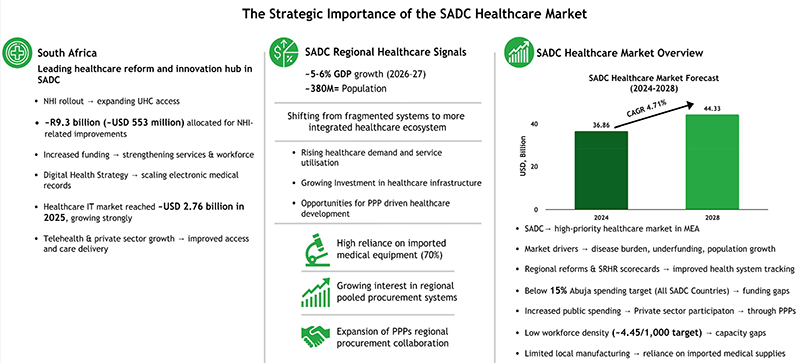
The Southern African Development Community (SADC) is emerging as an important healthcare sub-region within the MEA market. The region has a population of more than 380 million people and demand for healthcare services, diagnostics, laboratory systems and medical equipment is increasing steadily.
The SADC healthcare market is projected to reach around USD 44.33 billion by 2028, expanding at a CAGR of approximately 4.7%. Growth is supported by expanding healthcare infrastructure, rising demand for specialised care and increasing private sector participation in markets such as South Africa, Angola and Tanzania.
However, several structural challenges remain. Many SADC countries continue to spend below the African Union’s 15% Abuja healthcare spending target, highlighting ongoing investment gaps in infrastructure and services. The region also relies heavily on imported medical equipment, diagnostics and healthcare technologies, creating opportunities for distributors and suppliers.
Supported by SADC Vision 2050, governments are encouraging digital health adoption, stronger supply chains and public–private partnerships to improve healthcare access and modernise care delivery across the region.
Market landscape
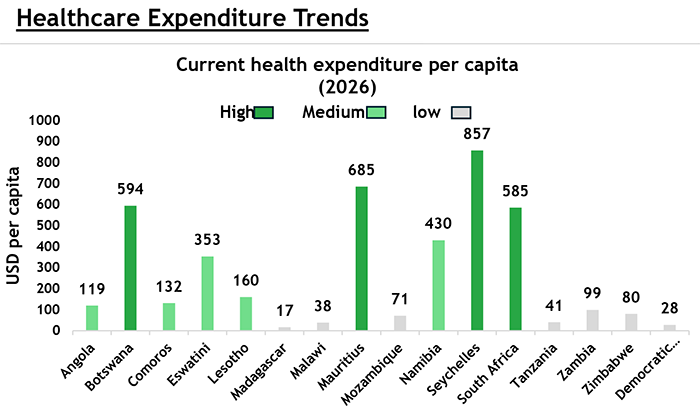
- Seychelles (~USD 857), Mauritius (~USD 685), Botswana (~USD 594) and South Africa (~USD 585) lead the region with stronger healthcare infrastructure and private sector participation.
- Mid-spending markets such as Namibia (~USD 430) and Eswatini (~USD 353) show moderate capacity.
- Lower-spending markets including Tanzania (~USD 41), Mozambique (~USD 71), Malawi (~USD 38) and Madagascar (~USD 17) remain underfunded.
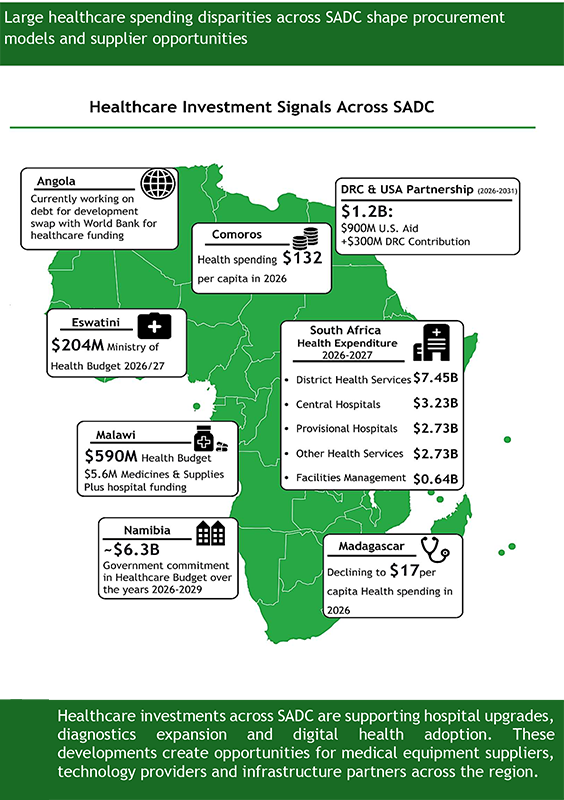
These gaps highlight opportunities for medical equipment suppliers, diagnostics providers and healthcare investors.
Market implication
- Public procurement will dominate, requiring strong tender skills and local partnerships.
- Spending disparities create two demand segments: private healthcare markets and donorsupported public systems.