

Subscribe to WHX Insights newsletter
Stay at the forefront of healthcare trends & innovations
Explore how Africa and the GCC are transforming procurement systems and why an intelligence-led, outcome-oriented approach is critical for health system resilience.

Healthcare procurement in Africa and the GCC is transitioning from fragmented, price-led buying toward strategic, value-based supply architectures. Facing a 70% to 90% reliance on foreign medicine imports, African health systems are leveraging pooled procurement, digital supply integration, and regional manufacturing commitments to build supply chain resilience. By linking GCC investment capital, logistics infrastructure, and purchasing scale with Africa’s expanding demand, this cross-border alignment mitigates global disruptions, ensures medicine availability, and optimizes long-term health expenditure across both regions.
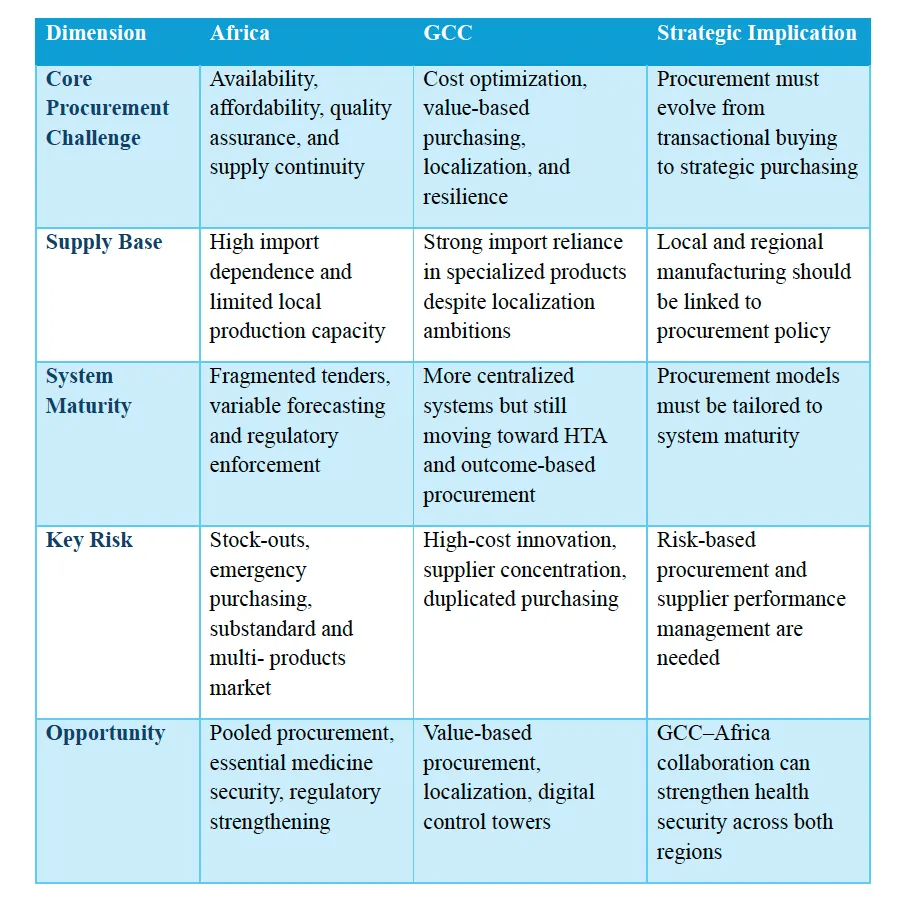
Healthcare procurement has moved from a back-office purchasing function to a strategic lever for access, system resilience, and cost optimisation. This shift is most urgent in Africa, where procurement weaknesses directly affect medicine availability, product quality, and out-of-pocket spending, and increasingly relevant in the GCC, where health systems are moving from volume-led procurement toward value-based purchasing, localisation, and supply security.
Modern healthcare procurement solutions are no longer about obtaining the lowest price; they now determine whether health systems can secure essential medicines, vaccines, diagnostics, medical devices, and consumables at the right quality, price, and time. Procurement failures translate directly into patient harm, through stock-outs, substandard products, or unaffordable medicines.
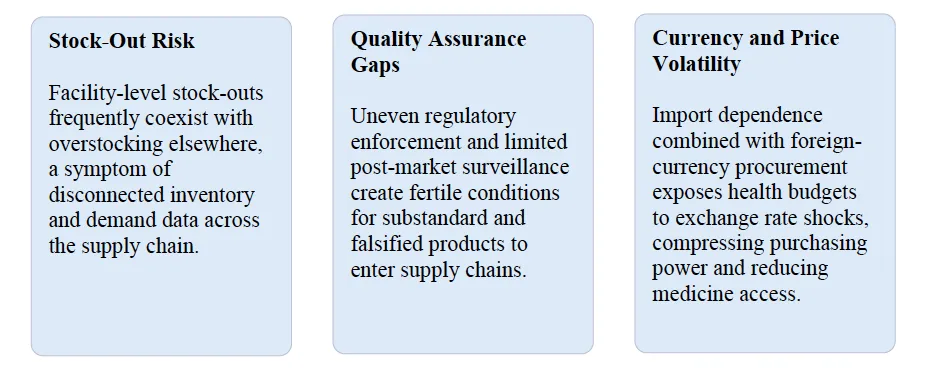
In Africa, healthcare procurement is evolving amid ongoing efforts to strengthen supply resilience, forecasting capabilities, regulatory systems, and access to essential healthcare products. Import dependence and fragmented purchasing structures continue to shape procurement priorities across many markets. The continent's health systems often operate in reactive mode, purchasing in emergencies, at higher unit prices, with limited visibility into facility-level inventory.
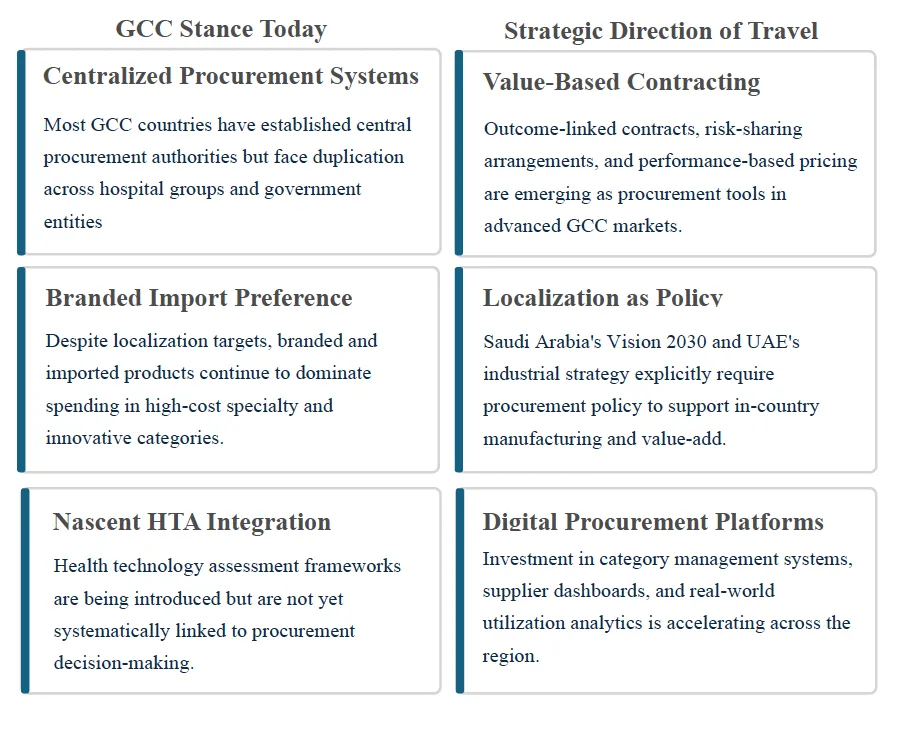
In the GCC, the agenda is increasingly linked to healthcare transformation, cost optimisation, localisation, value-based care, and strategic supply security. Countries such as Saudi Arabia and the UAE are not primarily constrained by availability; instead, they are working to optimise health expenditure, link purchasing to outcomes, and reduce reliance on branded imports.
In both contexts, the strategic imperative is the same: move procurement from a transactional, price-focused function to a value-driven, intelligence-led capability that supports health system resilience.
Despite distinct maturity levels and system architectures, Africa and the GCC face a shared strategic imperative: to shift procurement from a price-led, reactive function toward a resilient, value-based, and intelligence-driven capability.
Local and regional manufacturing should be treated as a procurement policy tool, not only an industrial policy ambition. By deploying collaborative healthcare procurement solutions, GCC capital, logistics platforms, regulatory maturity, and purchasing scale can be linked with African demand, regional manufacturing sites, and enabled market access. The opportunity is not to localise everything, but to prioritise essential medicines, vaccines, diagnostics, sterile injectables, insulin, PPE, and high-burden disease products.
Capital and investment platforms
Logistics and distribution hubs
Regulatory maturity
Healthcare transformation experience
Purchasing scale and leverage
Joint procurement platforms
Local manufacturing investments
Technology and knowledge transfer
Shared quality assurance systems
Strategic stockpile coordination
Essential medicine access and affordability
Vaccine and diagnostics security
Manufacturing scale-up capability
Regulatory harmonisation support
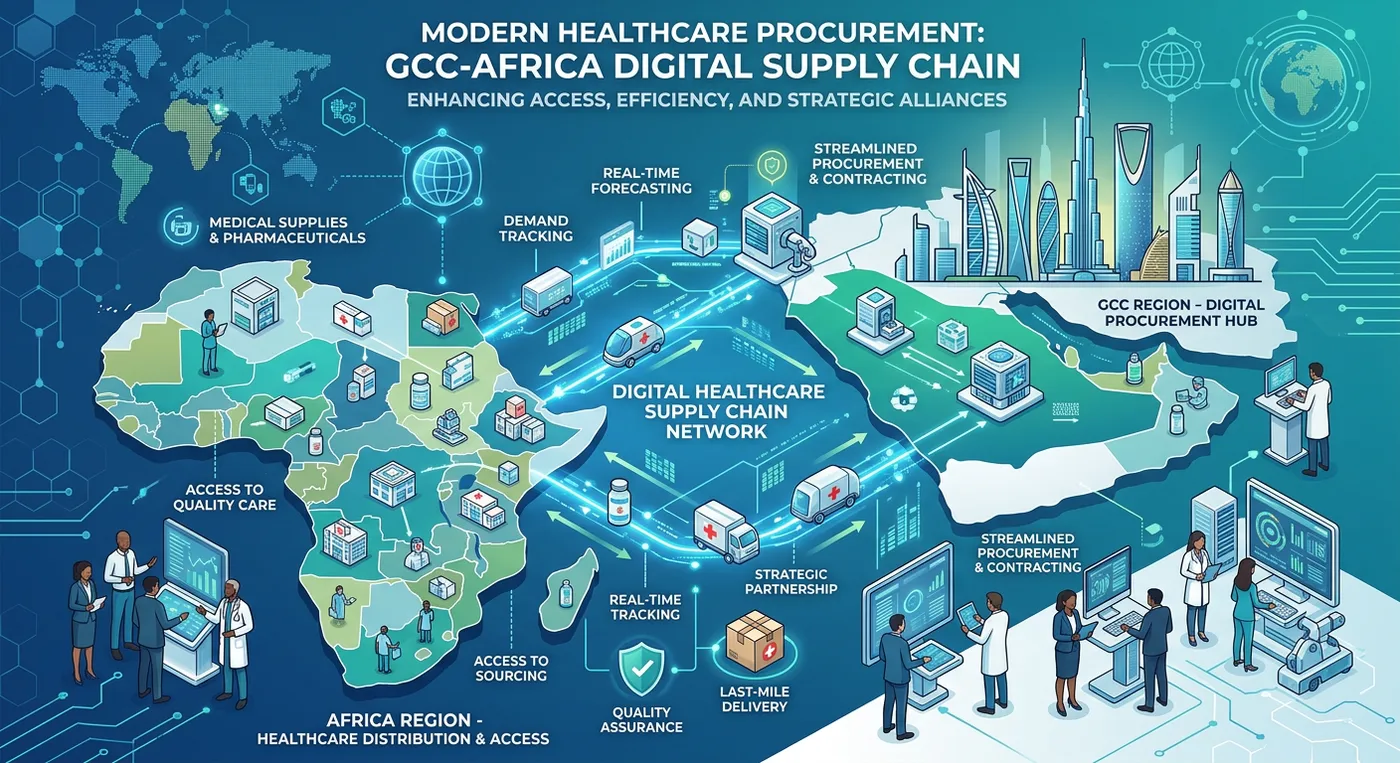
A stronger GCC-Africa procurement partnership could create benefits that extend beyond individual transactions or manufacturing investments. By connecting GCC capital, purchasing power, logistics capabilities, and regulatory experience with Africa's growing healthcare demand, manufacturing potential, and regional market integration, both regions can build a more coordinated health supply architecture.
For African health systems, this could improve the availability and affordability of priority medicines, vaccines, diagnostics, and medical supplies while reducing exposure to global supply disruptions and emergency purchasing. Longer-term procurement agreements and aggregated demand could provide manufacturers with greater volume certainty, supporting sustainable local and regional production. For GCC countries, the partnership could diversify supplier networks, reduce overdependence on a limited number of international production hubs, and create access to new healthcare investment and manufacturing opportunities. African manufacturing platforms could also become part of GCC strategic sourcing and stockpile strategies, particularly for essential and high-demand products.
The shared outcome would therefore be greater regional health security, improved purchasing efficiency, stronger supply continuity, and reduced procurement risk. Rather than operating only as investors and buyers, GCC and African stakeholders could become long-term partners in developing manufacturing capacity, quality systems, resilient supply chains, and more predictable healthcare markets.
Healthcare procurement is becoming one of the most important strategic capabilities within modern health systems. In Africa, the immediate priority is to strengthen access, affordability, quality assurance, demand visibility, and supply continuity while in the GCC, the focus is shifting toward value-based purchasing, cost optimisation, localisation, supplier diversification, and strategic supply security.
Although the two regions begin from different positions, their procurement priorities are increasingly converging. Both require stronger demand forecasting, better use of procurement data, improved supplier performance management, greater coordination between regulators and purchasers, and procurement models that reward long-term value rather than the lowest initial price. The next phase of procurement transformation should therefore focus on building intelligence-led and outcome-oriented systems. This includes pooled and centralised purchasing where appropriate, digital procurement control towers, risk-based supplier management, stronger quality assurance, and carefully targeted local and regional manufacturing.
By aligning investment, procurement commitments, and advanced healthcare procurement solutions, both regions can drive manufacturing development, technology transfer, and regulatory cooperation to create a more resilient healthcare supply system. The ultimate objective is not simply to purchase products more efficiently, but to ensure that the right healthcare products consistently reach the right patients, at the required quality, at an affordable cost, and without disruption.
Healthcare procurement is evolving from a traditional, price-led purchasing function into a strategic lever for health system resilience and value-based care. Africa is focusing on improving medicine availability and reducing out-of-pocket costs, while the GCC is prioritizing cost optimization, local manufacturing, and supply security.
African health systems face heavy import dependence, fragmented purchasing structures, and limited inventory visibility. These factors lead to reactive emergency purchasing at higher unit prices, frequent product stock-outs, and increased financial burdens on patients.
Traditional procurement focuses primarily on obtaining the lowest initial unit price. In contrast, value-based procurement links purchasing decisions to long-term clinical outcomes, product quality, supply continuity, and overall health system resilience.
A GCC-Africa partnership combines GCC investment capital, logistics hubs, and purchasing scale with Africa’s expanding healthcare demand and regional manufacturing potential. This collaboration accelerates local production of essential medicines, vaccines, and diagnostics while diversifying supply networks for both regions.
Explore more industry trends, regional supply chain strategies, and expert healthcare management insights at WHX Insights.

WHX Nairobi
Sep 15, 2027 TO Sep 17, 2027
|Nairobi, Kenya
Join us at WHX Nairobi—East Africa's #1 healthcare event. WHX Nairobi unites thousands of healthcare professionals under one roof to learn, trade, and network. It provides a platform to showcase healthcare innovations, attract investment, and position Kenya as a regional medical hub.