Subscribe to WHX Insights newsletter
Stay at the forefront of healthcare trends & innovations
The business impact of artificial intelligence across drug discovery workflows.
September 21, 2026
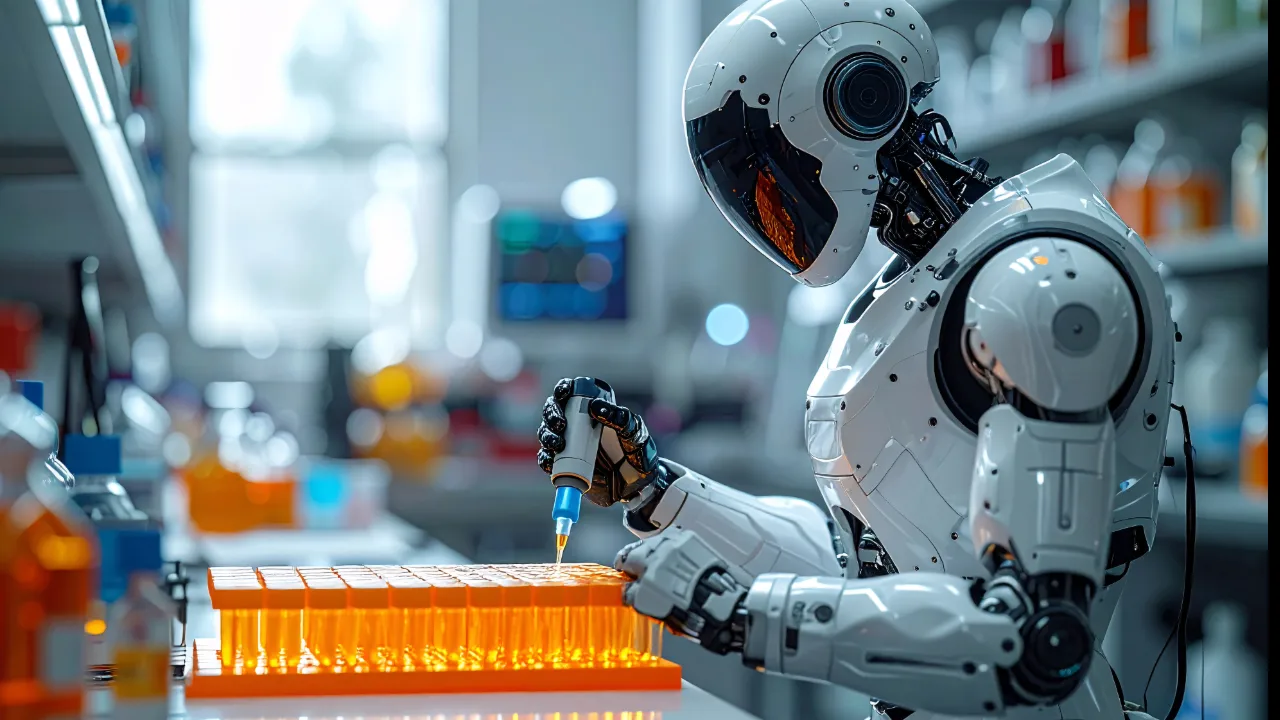
Artificial intelligence (AI) in drug discovery is showing promising early results as AI moves deeper into target identification and molecule design, changing how scientists develop new medicines.
AI accelerates drug discovery by improving target identification, utilising tools like AlphaFold for protein structure prediction, and enabling generative models to design novel molecular structures. While AI-discovered candidates achieve an 80-90% success rate in Phase I clinical trials, Phase II rates hover around 40% — highlighting that digital biology predictions must ultimately be paired with rigorous laboratory and human clinical validation.
Drug discovery has never been short of promising ideas. The challenge is how many of them fail. Developing a new medicine can mean searching for millions of potential compounds and conducting years of experiments before a candidate ever reaches patients, with no guarantee of success.
AI could potentially help improve those odds. A 2024 analysis published in Drug Discovery Today found that AI-discovered molecules had an 80–90% success rate in Phase I clinical trials, substantially higher than historical industry averages, which the study benchmarks at roughly 40–65%.
The sample remains relatively small, but the findings point to a bigger shift: AI is increasingly helping scientists decide what to investigate in the first place.
This shift sits at the heart of digital biology, where computational tools and experimental science work closely together.
AI can sift through huge volumes of genomic, proteomic and clinical data, looking for connections that would be difficult for researchers to spot on their own. These patterns can reveal clues about disease and promising therapeutic targets, helping scientists focus their efforts before entering the lab.
Generative AI takes this a step further. Traditionally, researchers would screen large libraries of existing compounds in search of one that shows promise. Now, AI models can potentially propose entirely new molecular structures designed with particular properties in mind.
A 2024 review in Frontiers in Pharmacology highlighted uses ranging from predicting molecular properties and virtual screening to planning how compounds could be synthesised and generating new molecules from scratch.
Put simply, scientists are no longer asking AI to find the needle in the haystack. Increasingly, they can ask it to help design the needle.
Perhaps the best-known example of AI's potential in biology is EMBL’s European Bioinformatics Institute (EMBL-EBI) and Google DeepMind’s AlphaFold. Proteins are central to almost every biological process, and understanding their three-dimensional structures can offer clues about disease and how potential drugs might interact with them.
AlphaFold has reportedly expanded what researchers can predict computationally: its database contains more than 200 million protein structure predictions, and DeepMind says the technology has been used by more than three million researchers across over 190 countries.
For drug discovery, that matters because understanding a protein's structure can give scientists a valuable starting point. It can help them explore disease biology, investigate potential targets and think differently about how a drug might be designed to interact with them.
The real test for AI, however, is not how many molecules it can generate. It is whether those molecules eventually become safe and effective medicines.
While the Drug Discovery Today analysis found high success rates for AI-discovered molecules in Phase I trials, the Phase II success rate was around 40%, much closer to historical industry performance. The number of AI-discovered drugs that have progressed this far also remains relatively small.
That highlights one of the hardest problems in medicine. AI may be getting better at identifying promising candidates and predicting useful drug-like properties, but the human body is vastly more complicated than any computer model. A molecule that looks promising on screen or in the laboratory still has to prove that it can safely and effectively treat disease in people.
Digital biology is not about replacing scientists or laboratories.
Predictions still need experimental validation, and potential medicines must pass rigorous clinical trials. Instead, AI can help scientists narrow the field earlier, explore possibilities that might otherwise be missed and make better-informed choices about what to pursue.
The future of drug discovery is not a choice between AI and the laboratory. The opportunity lies in bringing the two closer together. If that partnership lives up to its early promise, digital biology could do more than make drug discovery faster. It could give scientists a smarter route from understanding a disease to finding new ways to treat it.
References available upon request.
AI is used to analyse vast volumes of genomic, proteomic, and clinical data to identify disease targets. Generative AI models can also design entirely new molecular structures from scratch, predict molecular properties, and optimise compounds before lab testing.
According to a 2024 analysis in Drug Discovery Today, AI-discovered molecules achieved an 80-90% success rate in Phase I clinical trials, significantly higher than historical industry averages of 40-65%. However, Phase II success rates remain closer to industry averages at around 40%.
Developed by EMBL-EBI and Google DeepMind, AlphaFold predicts 3D protein structures, providing researchers with over 200 million structural predictions. Understanding protein structures gives scientists a clear starting point to explore disease biology and design targeted drugs.
No. AI is designed to complement scientists, not replace them. While computational tools narrow down candidate molecules and predict properties, experimental validation in laboratories and rigorous human clinical trials remain essential to ensure safety and efficacy.
While AI excels at early-stage target identification, molecule generation, and Phase I safety testing, Phase II efficacy trials require proving that a candidate can safely treat disease in complex human biological systems. As highlighted in recent analyses, Phase I success rates reach 80–90%, but Phase II rates drop to ~40% because computational predictions must still be validated against real-world biological complexity, patient variability, and clinical efficacy.

World Health Expo
Jan 25, 2027 TO Jan 28, 2027
|Dubai, UAE
Join us at World Health Expo (WHX) in Dubai — where the world of healthcare meets. WHX connects the healthcare industry's leading researchers, developers, innovators, and professionals all in one place. Whether you're on the hunt for a new product or service, want to learn from world-renowned speakers, or expand your professional network, WHX in Dubai has everything you need to thrive in the Middle East's healthcare industry.