

Subscribe to WHX Insights newsletter
Stay at the forefront of healthcare trends & innovations
From managing anxiety to supporting rehabilitation, sound therapy, an almost US$5 billion market, is emerging as a new model for delivering care.
April 27, 2026
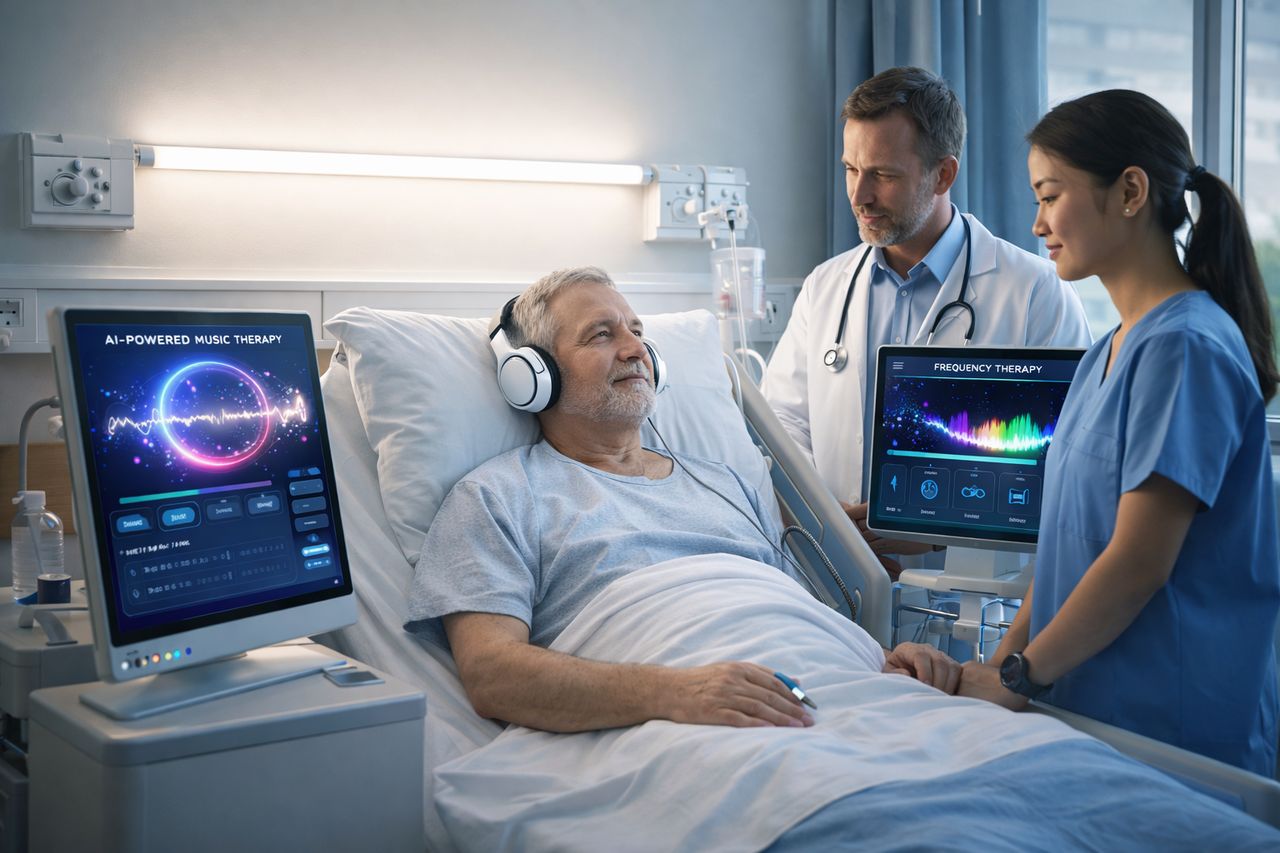
A meaningful shift is taking place at the intersection of healthcare, artificial intelligence, and music. What was once dismissed as niche wellness is being taken seriously as a scalable, non-invasive category of care: AI-driven music and frequency-based therapies.
For healthcare investors, the appeal is clear. These solutions sit at the convergence of several high-growth markets — digital therapeutics, mental wellness, sleep health, and wearable devices — while offering a new way to deliver care that is both personalised and engaging. The promise for clinicians and patients alike is just as compelling: tools that promise to reduce stress, improve sleep, facilitate rehabilitation, and augment current therapies without adding to the current burden of medication.
From a market perspective, the opportunity is substantial:
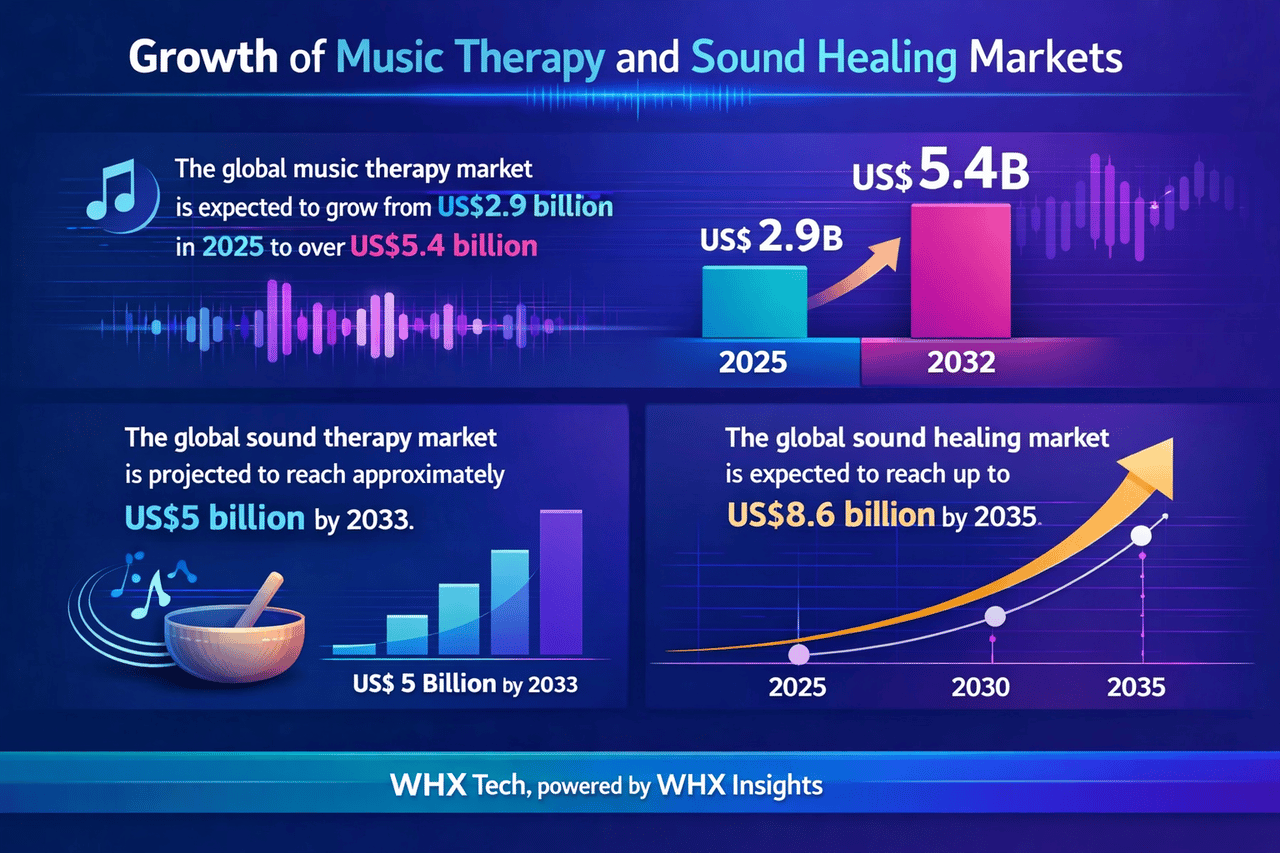
Image generated by AI, reviewed by humans
At the same time, adjacent sectors are expanding rapidly: the digital therapeutics market is forecast to exceed US$25 billion by 2030, the sleep technology market is expected to surpass US$40 billion, and the mental wellness market already exceeds US$400 billion globally.
These numbers are reinforced by underlying demand. The World Health Organization (WHO) states that more than 970 million people worldwide suffer from a mental health disorder, thus emphasising the need for an effective solution, particularly one that is not pharmacological. As healthcare systems become increasingly overwhelmed, digital, remote, and cost-effective solutions are growing in popularity.
Few individuals exemplify this convergence better than Grammy-nominated producer Maejor Ali, founder of Frequency School, who hosted a session at the first edition of WHX Tech titled, ‘Designing health tech that resonates across borders’. He shared:
“Because of my experience of getting cancer in my 20s, I started looking into all sorts of healing modalities. What really resonated for me was sound and frequencies. That experience has led me to where my bigger goal is now, which is to get sound healing embedded in people’s everyday listening experiences.”
This is an important goal because perhaps the biggest challenge facing healthcare innovation is adoption. Even if an innovation is very powerful, if it doesn’t fit comfortably in a person’s life, it will not be used. One of the biggest reasons sound healing has a chance to succeed where other innovations might not is that sound is already an integral part of our daily lives. People naturally use sound to control their mood, enhance their concentration, and reduce their stress levels.
One of the most well-researched methods in this area is binaural beats, in which different tones are played in each ear, creating a third sound in the brain. It has been shown to positively affect brain activity, which can be measured using an EEG. As Ali said, “seeing that 'your brainwave state changes by listening to these frequencies' was a big part of helping to prove the theory.”
Scientific data is also starting to emerge. A 2025 randomised controlled trial suggested that using EEG-guided binaural beats could enhance not only relaxation but also cognitive ability. A review published in Frontiers in Digital Health suggested that certain frequency bands could potentially enhance focus and memory.
The above is being accelerated by AI technology, which can analyse biometric data such as heart rate variability, sleep patterns, and stress levels, then create a soundscape tailored to the individual. For example, a person with anxiety may be exposed to soothing, low-frequency sound. In contrast, a person who needs cognitive enhancement may be exposed to a completely different type of stimulation. Unlike pharmaceuticals, these treatments do not need to be standardised and can vary from individual to individual.
In the domain of sleep health, sound-based systems are being utilised to counter a global epidemic of sleep disorders.
According to estimates, up to 30-40% of the global adult population suffers from sleep disorders, creating a massive opportunity for sound-based solutions. In the area of pain management, sound and vibration therapies are being researched as an alternative to painkillers. In neurological rehabilitation, sound-based systems are being researched for their efficacy in motor and cognitive rehabilitation.
This shift is no longer exclusive to startups or the wellness community. Several health tech and music companies are entering this space. At the same time, healthcare innovators are creating solutions that range across prevention, treatment, and rehabilitation. Regulatory frameworks and reimbursement models are still evolving, but momentum is clearly building.
For investors, the question is no longer whether this category will grow — it is who will define it.
The infrastructure is forming, the science is advancing, and user behaviour is already aligned. In a healthcare system that is constantly on the lookout for scalable, human-centric innovation, the next big thing may not be a pill, but something as simple yet powerful as sound.

Sep 14, 2026 TO Sep 16, 2026
|Dubai, UAE
Join us at WHX Tech in Dubai—where digital healthcare innovation meets real-world impact. WHX Tech brings together healthcare leaders, tech innovators, and investors to tackle the industry's biggest challenges and shape the future of healthcare.