

Subscribe to WHX Insights newsletter
Stay at the forefront of healthcare trends & innovations
ScienceSoft leads with a sophisticated solution that is redefining autonomy in healthcare.

Sponsored by ScienceSoft

Do you think it is realistic for a healthcare AI agent to answer every patient call and resolve most requests at first contact?
Healthcare decision-makers usually react to this idea with skepticism. In Hyro’s 2023 survey, 200 senior US healthcare call centre leaders indicated they would be satisfied with an AI tool that could automate, on average, 34% of inbound calls. It reflects today’s comfort zone, since many still picture AI as an FAQ chatbot that only answers simple questions. Anything more complex — like “I need to reschedule this appointment and also plan another procedure on the same day, but only if it’s covered by my insurance” — is reserved for the front desk.
However, the concept of a chatbot has completely changed, and a modern chatbot is, in fact, an agent. And it is entirely realistic for a front-door agent to manage a request like this end-to-end. Multi-agent systems can switch from booking and rescheduling appointments to handling payment and coverage questions, answering callers’ requests, and delivering instructions. Meanwhile, human staff can focus on exceptions, highly complex cases, and oversight.
ScienceSoft’s engineers have built a prototype of a healthcare AI multi-agent system for call centre automation. At WHX Dubai 2026, we will present a demo of multi-intent call handling, and attendees will be able to try the prototype on site. This article breaks down the design choices and controls that make this level of automation possible in regulated healthcare settings.
What sets an AI agent apart from a regular chatbot is the degree of autonomy. If chatbots only answer questions, an agent can complete an action, like booking an appointment and sending directions to the patient, without involving human staff.
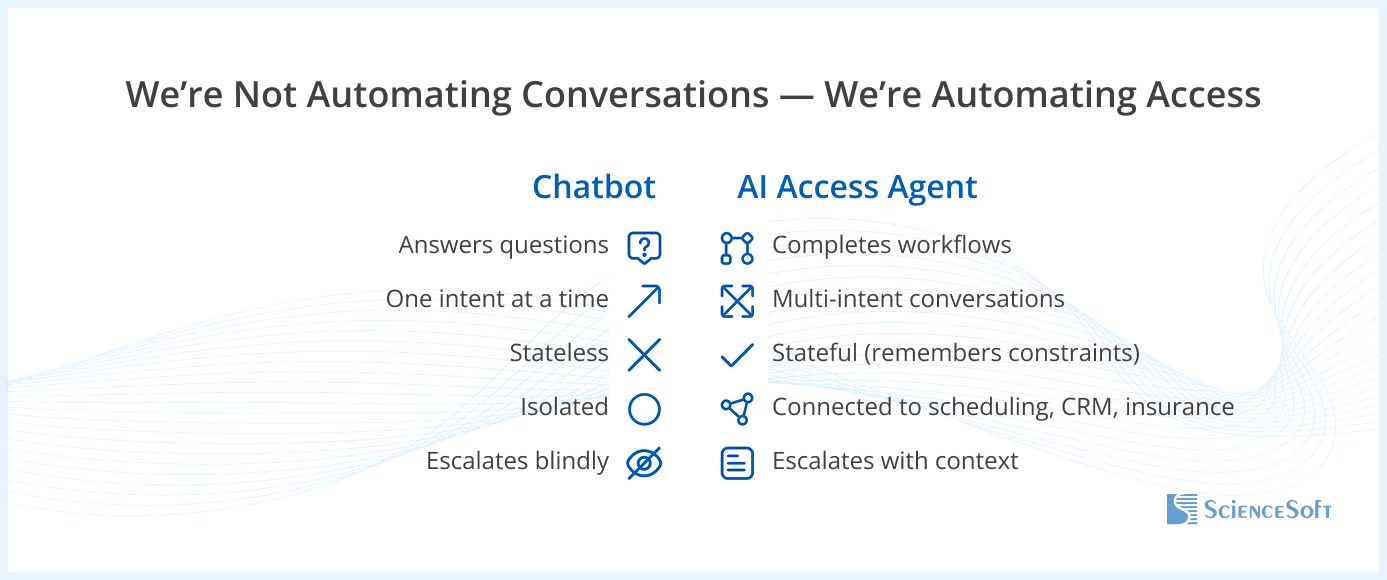
An AI front door takes patient requests and then comes back with a completed outcome, such as a new slot confirmed and directions sent. In a typical call scenario, a voice AI agent processes unstructured human speech and identifies the patient, their intent (e.g., to book an appointment), the doctor they want to see, the time window, and other essential information. AI then executes the action in scheduling and CRM systems, pulls provider-approved preparation steps from the knowledge base, and delivers the outcome via a voice call, WhatsApp, or web chat.
However, it doesn’t mean an agent can become the sole decision-maker for all patient requests. Any clinical judgement, exception handling, and QA oversight should always stay on the human side. When high-risk symptoms or uncertainty appear, the agent does not interpret or guess. For example, chest pain, severe shortness of breath, or suicidal ideation triggers an immediate stop rule and escalation to the appropriate human or emergency pathway.
“AI Front Door means workflow completion, safe integration, and reliable escalation. That is why it can handle routine calls at scale."
Healthcare contact centres handle many repeatable caller intents, such as booking, asking for location guidance, clarifying insurance coverage, or confirming how to prepare for a test. One approach is to build a single super-agent that tries to cover everything. However, in this setup, any change to the agent’s logic in one workflow (e.g., booking) will require retesting and reapproving the entire system, since the interconnected flows have a risk of affecting each other. This drives AI maintenance costs in the long run.
ScienceSoft proposes a multi-agent model instead, which is now a recognised direction in mainstream AI research. A front-door orchestrator starts the conversation, clarifies the caller's request, and preserves context. It then routes the patient’s request to a specialised agent, trained and governed for a single domain, such as ID checks, scheduling, billing, or giving pre-procedure instructions. If the request spans domains, the orchestrator assembles a step-by-step task plan and switches between agents.
This approach supports control at scale:
Governance stays practical, since each specialised agent remains narrow, testable, and easier to approve.
Changes stay safer and cheaper, since updating one area does not destabilise the others.
The orchestrator enforces scope boundaries and call duration limits to keep the system focused.
When a stop rule triggers escalation, the agent provides a concise summary of what was requested, what was completed, and what still requires a human decision.
Real calls rarely arrive as a single, tidy request. A patient may open with a long story, switch from Arabic to English, and ask for three things before the agent can respond. They want to move an appointment, confirm the address, and understand coverage for a planned test. After the agent offers a slot, the patient changes their mind and adds one more constraint.
A front-door agentic system stays stable in that chaos because it treats the call as a sequence of tasks rather than a single question.
Firstly, the orchestrator keeps track of what has already been confirmed, what options were offered, and which constraints the caller set. When the patient backtracks, the orchestrator edits the existing plan instead of restarting the conversation.
Secondly, the agent monitors how confident it is about what it just heard and what the caller wants, and it asks brief clarifying questions when that confidence drops. If the caller describes a potential red flag or the conversation becomes hard to interpret due to noise or accents, the agent escalates the call to a human with a structured summary.
Thirdly, the orchestrator handles multiple intents by closing one workflow (e.g., patient ID check), confirming the outcome (identity match), and then returning to the subsequent open request (reschedule an appointment).
The result is one continuous experience for the patient, with humans stepping in only when the case needs clinical judgment or oversight.
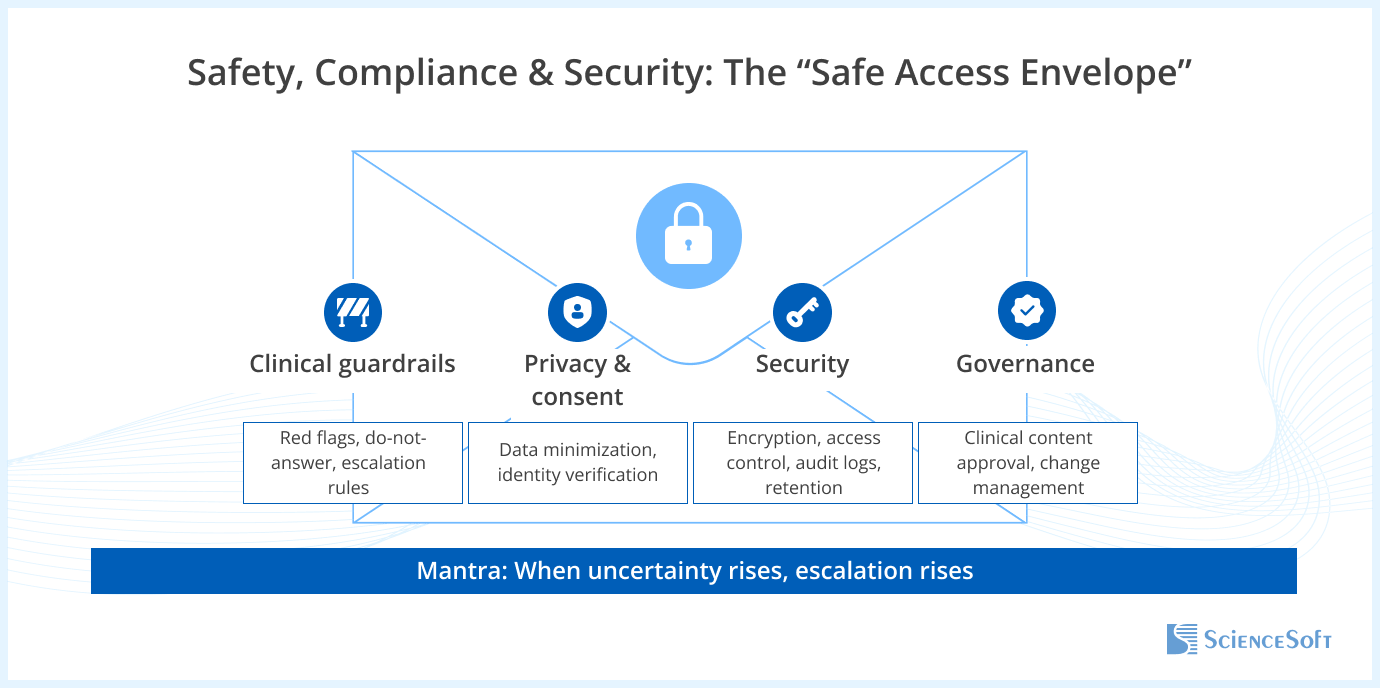
In an AI-first contact centre, safety is built into the architecture. The same multi-agent system that makes automation scalable also keeps it inside a safe access envelope.
The front-door orchestrator acts as the safety governor. It identifies patient intent, checks speech recognition confidence, and decides whether the call stays in the access lane or moves to a human team.
Specialised agents do narrowly defined work. A scheduling agent can change a slot, confirm the right branch, and send a WhatsApp confirmation, yet it has no path to clinical advice. An instructions agent delivers provider-approved preparation steps but rejects symptom questions instead of guessing.
Auditability closes the loop. Each decision, tool action, and handoff is recorded with timestamps, policy outcomes, and a minimal-necessary transcript, so supervisors can review what happened, understand why it happened, and adjust rules or routing with confidence.
The multi-agent architecture also supports data privacy and compliance because the orchestrator enforces least-privilege access, minimises data shared across agents, and writes auditable action logs with defined retention.
ScienceSoft demonstrated this approach live at WHX Dubai 2026, with an interactive demo that lets the multi-agent model speak for itself.
References available on request.

World Health Expo
Jan 25, 2027 TO Jan 28, 2027
|Dubai, UAE
Join us at World Health Expo (WHX) in Dubai — where the world of healthcare meets. WHX connects the healthcare industry's leading researchers, developers, innovators, and professionals all in one place. Whether you're on the hunt for a new product or service, want to learn from world-renowned speakers, or expand your professional network, WHX in Dubai has everything you need to thrive in the Middle East's healthcare industry.