

Subscribe to WHX Insights newsletter
Stay at the forefront of healthcare trends & innovations
The complete operational roadmap for scaling agentic AI and physical hospital robotics beyond pilots, covering ROI, governance, and adoption strategy.

Agentic AI and physical AI are moving rapidly into real-world healthcare use, but turning promising applications into scaled deployments remains a significant challenge.
Agentic AI systems that can plan and execute tasks with limited human intervention, and physical AI systems that sense and act in the real world, are no longer confined to conference-stage concept discussions. On the contrary, these technologies increasingly demand board-level decisions about testing and implementation.
Even so, most of these projects still stall before they reach scale. This feature article sets out the factors that Chief Information Officers, Chief Medical Officers, Chief Financial Officers, Chief Innovation Officers and quality and safety leads in the healthcare sector should consider when moving from pilot to full deployment, and what separates a scaled system from a stranded one.
Deloitte’s 2026 US Health Care Outlook Survey found that more than 80% of healthcare executives expect agentic AI and generative AI to deliver moderate-to-significant value across clinical, business and back-office functions this year.
Yet while around 70% of healthcare organisations are now actively using AI, only about 3% have deployed AI agents into live clinical workflows. The gap between intent and operation is where most transformation budgets are currently sitting idle.
Most pilots fail to scale because they’re built for a demo, not a production environment. Gartner projects more than 40% of agentic AI projects will be cancelled by the end of 2027, driven by escalating costs, unclear business value and inadequate risk controls. In hospitals specifically, that means messy legacy data, fragmented electronic health record (EHR) integrations and clinical risk tolerances that a clean pilot environment never has to face.
Operationalising agentic AI in healthcare fails when a single function owns the project and others inherit the consequences. A shared view of priorities across C-suite leadership ensures seamless adoption on the hospital floor.
Stakeholder | Core priority |
|---|---|
Chief Information Officer | Integration architecture, data readiness, scalability |
Chief Medical Officer | Clinician adoption, training pathways, patient outcomes |
Chief Financial Officer | Budget models, funding mechanisms, cost-effectiveness |
Chief Innovation Officer | Competitive positioning, organisational change, ROI narrative |
Quality and safety lead | Evidence thresholds, validation, risk mitigation |
Adoption succeeds when clinical staff experience AI as workload relief, not workflow disruption. Diligent Robotics' Moxi mobile manipulation robots have completed over one million hospital deliveries, saving staff more than 1.5 billion steps and half a million hours previously spent on manual restocking and delivery tasks. That kind of measurable time return, backed by structured training and a clear escalation path to human judgement, is what converts scepticism into uptake.
Explore more medical AI and automation coverage from WHX Insights
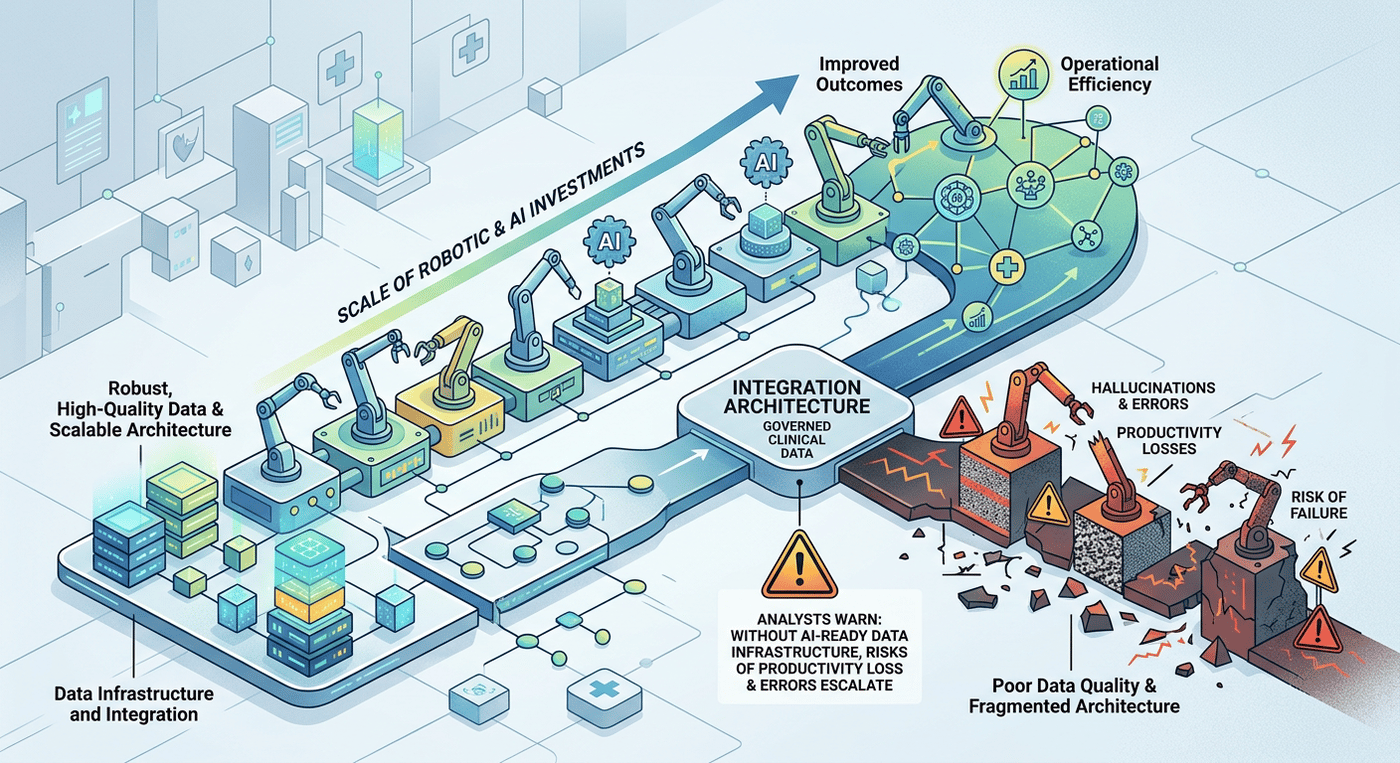
Scalability depends on data quality and integration architecture more than on the sophistication of the model itself. Analysts warn that organisations without AI-ready, well-governed clinical data risk productivity losses from hallucinations and errors as automation expands, making data infrastructure (rather than algorithm selection) the most pressing engineering challenge.
Robotics investment cases increasingly rest on hard market and utilisation data, rather than projected efficiency gains alone. The global medical robotics market is projected to grow from $13.7 billion in 2025 to $27.1 billion by 2030, while the hospital logistics robots segment is expected to grow from $2.9 billion in 2026 to $4.24 billion by 2032. C-suite leaders need to model funding in phases tied to demonstrated workflow savings, not a single capital outlay against a multi-year efficiency promise.
Safe scaling requires clinical guardrails and audit trails built into the system architecture. The retrospective implementation of these checks and balances is likely to prove ineffective, whether in terms of cost, operational efficiency or risk management.
Defined escalation rules for high-risk symptoms or edge cases, combined with full action logging, let quality and safety leads review decisions and adjust routing without halting the whole system, which is what separates governed automation from a compliance liability.
Ultimately, the opportunities offered by the roll-out of agentic and physical AI on the hospital floor far outweigh the drawbacks, but the journey from pilot to full-scale deployment will not forgive half measures.
Physical AI refers to AI systems embedded in robots or devices that perceive and act in the physical world, such as delivery robots, surgical platforms and diagnostic imaging hardware, as distinct from software-only agentic AI.
No. Current deployments handle logistics, scheduling and narrow decision support, while clinical judgement, exception handling and patient communication remain with staff. Adoption strategies work best when framed as workload relief rather than replacement.
Timelines vary by use case and data readiness, but health systems typically need a phased approach spanning workflow selection, data audit, supervised piloting and multi-agent orchestration before reaching sustained production use.
Common causes include unclear ROI targets, gaps in legacy system integration, and insufficient governance and risk controls, as well as treating a single pilot’s success as proof that the same system will be effective under full clinical load.
Traditional healthcare AI primarily focuses on diagnostic analysis, such as reading imaging or analysing clinical data. In contrast, agentic AI autonomously executes operational and administrative workflows, while physical AI introduces spatial intelligence and robotics into the physical hospital environment to handle physical tasks like logistics and deliveries.
Related reading:

WHX Tech
Jan 26, 2027 TO Jan 28, 2027
|Dubai, UAE
Join us at WHX Tech in Dubai—where digital healthcare innovation meets real-world impact. WHX Tech brings together healthcare leaders, tech innovators, and investors to tackle the industry's biggest challenges and shape the future of healthcare.