Subscribe to WHX Insights newsletter
Stay at the forefront of healthcare trends & innovations
A guide to evaluating ROI, cybersecurity risks, and public vs private adoption to invest in South Africa's diagnostics.
October 5, 2026
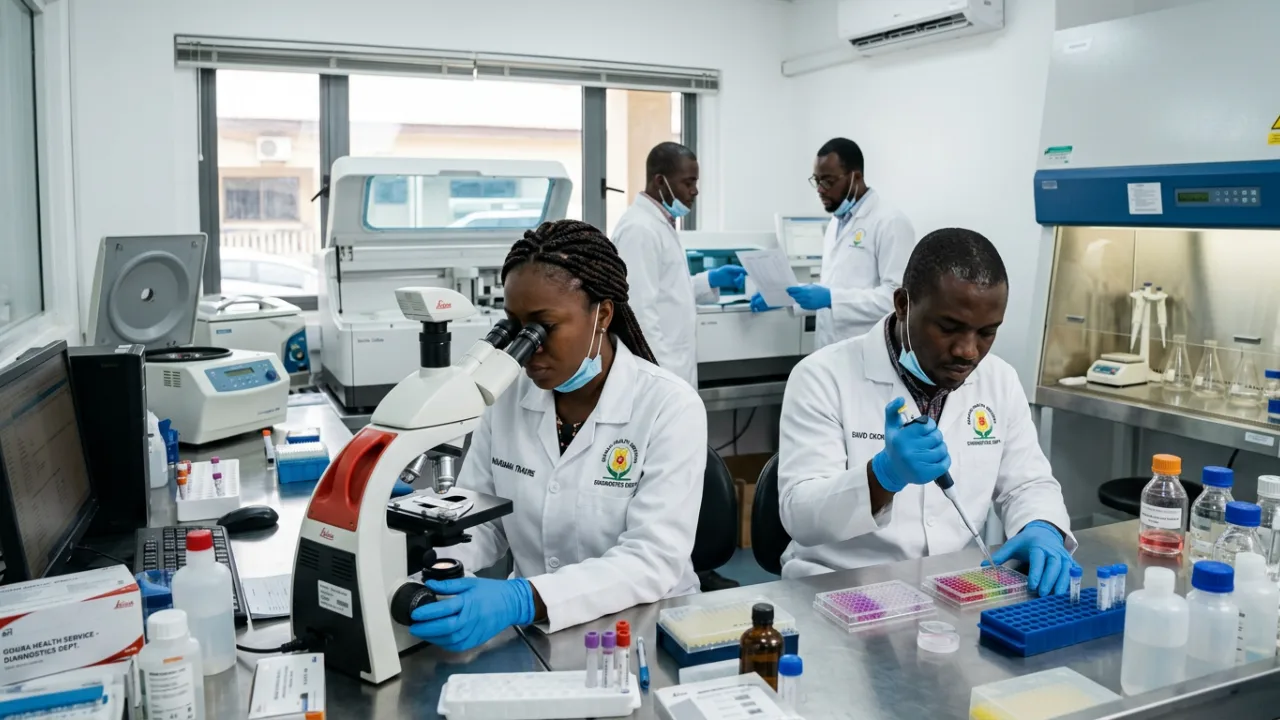
Laboratory automation in South Africa is evolving from a lab-floor upgrade to a board-level investment, balancing high throughput against rising cybersecurity risks and capital costs. While private networks like Ampath and Lancet lead in total automation, the public NHLS (processing ~400,000 daily tests) highlights the sector's core vulnerability following its 2024 ransomware breach. As South Africa's digital pathology market heads toward $16.7M by 2031, healthcare leaders must integrate automation alongside robust cybersecurity and workforce retraining.
South Africa’s diagnostic networks face a hard trade-off: laboratory automation cuts turnaround times and staff strain, but it raises capital costs, exposes legacy IT to the risk of cyberattack, and demands new training pipelines. The 2024 NHLS ransomware attack shows what’s at stake when automation outpaces cybersecurity investment. This article sets out the business case, the risks, and where public and private providers currently diverge.
Laboratory automation is becoming a board-level decision for South Africa’s diagnostic networks, not just a lab-floor upgrade. As disease burden, staffing shortages and cyber risk collide, hospital directors and lab network CFOs are being asked to justify automation spend against tightening budgets, while a single security failure can undo years of efficiency gains overnight.
Laboratory automation refers to the implementation of automation in medical laboratory environments, utilising robotics, software and connected instruments to handle specimen processing, testing, and result reporting with minimal manual intervention. In South Africa, adoption is being pushed by rising chronic and infectious disease testing volumes, persistent staffing gaps, and pressure to cut turnaround times in both public and private pathology.
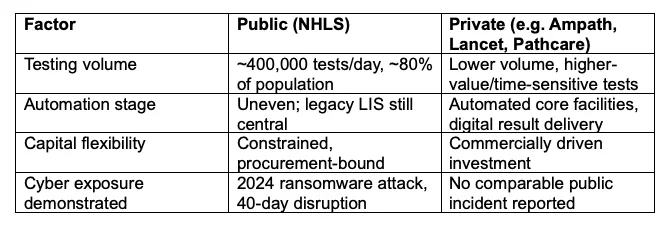
Private groups such as Ampath, Lancet Laboratories and PathCare have already introduced high-throughput equipment and automated dispensing machines for laboratories South Africa-wide to improve throughput, consistency and speed. Other benefits include digital results delivery and the ability to extend mobile specimen collection into rural and underserved regions. Meanwhile, South Africa’s public sector, which is dominated by the National Health Laboratory Service (NHLS), handles far higher volumes under tighter capital constraints.

On June 22, 2024, the BlackSuit ransomware group breached NHLS systems after an employee clicked a phishing link, disabling the TrakCare laboratory information system across the network for weeks. This event demonstrated that automation without matching cybersecurity investment is a liability, not an asset.
The scale of the disruption caused illustrates the stakes for any automation business case:
NHLS runs 265 laboratories serving roughly 80% of South Africa’s population
The service processes around 400,000 tests per day
IT systems were reported to be either wholly or partially inaccessible for 40 days
TB and HIV viral load results had to be relayed by phone as a workaround
South Africa’s Information Regulator has since queried NHLS’s compliance with the Protection of Personal Information Act at the time of the breach – a reminder that automation and digitisation projects now carry direct regulatory exposure, not just operational risk.
Private pathology groups in South Africa are further ahead on automation and digital pathology than the public system, largely because they can direct capital more flexibly. Meanwhile, the NHLS carries the bulk of national testing volume on comparatively constrained infrastructure.
According to research from MarketsandMarkets, South Africa’s digital pathology sector was valued at $10.6 million in 2026, and is expected to hit $16.7 million by 2031. With a projected compound annual growth rate of 9.6% during the period, the rate of adoption looks set to remain steady rather than explosive over the coming years.
Integrating modern laboratory automation systems into networks still running older laboratory information systems is difficult because it multiplies the points of failure, as seen when TrakCare’s compromise cascaded across NHLS’s entire results pipeline. Workforce readiness compounds this: automation shifts staff time towards oversight, quality control and incident response, rather than manual processing, which requires structured retraining – not just new equipment.
Rural and underserved areas need connectivity and logistics solutions that don’t bypass data protection and quality standards. Private providers have addressed this partly through mobile specimen collection models, which route samples into automated core labs rather than requiring full automation at every site – a pattern worth testing at public-sector scale.
While the challenges involved in laboratory automation are real, so is the cost of inaction. Rising testing volumes, chronic staffing gaps and turnaround delays aren’t going away, and the NHLS’s own post-attack remediation spend – more than $18 million on IT security alone – highlights the dangers of underinvestment in automation and cybersecurity.
It is true that public and private leaders face different constraints, but both must tackle the same underlying task regarding sequencing: proactively investing in cybersecurity and automation while funding the workforce retraining required for effective implementation.
Boards should require a documented incident response and business continuity plan as a condition of any automation capital approval. The South African Medical Journal’s (SAMJ) post-incident review of the NHLS attack sets out a practical starting template for this. Ultimately, leaders who treat laboratory automation as a single, coordinated investment – rather than tech now and security later – will be best placed to convert South Africa’s diagnostic pressures into a genuine efficiency advantage.
Network executives seeking to balance automation, cybersecurity, and operational challenges can register for WHX Johannesburg to explore the latest innovations and insights from across the healthcare sector.
Does laboratory automation increase cybersecurity risk?
Automation itself doesn’t create risk, but it increases the cost of a breach by centralising more of the testing pipeline in connected systems. The NHLS attack disabled ordering, results and reporting simultaneously because they ran through a single compromised system.
NHLS carries far higher testing volumes on public procurement budgets, which move more slowly than private capital allocation. This isn’t a technology gap so much as a funding and procurement-cycle gap.
An employee clicked a phishing link, giving the BlackSuit group access to NHLS’s database. The attack encrypted core systems, including the TrakCare laboratory information system, within hours.
Yes, mobile specimen collection feeding into centralised facilities equipped with automated dispensing machines for laboratories is already used by private providers to extend the benefits of automation to areas without reliable local infrastructure.

WHX Johannesburg
Oct 6, 2026 TO Oct 8, 2026
|Johannesburg, South Africa
Join us at WHX Johannesburg—where a trusted legacy meets the future of healthcare. WHX Johannesburg brings together local talent and global pioneers to explore breakthrough innovations, build transformative partnerships, and shape the future of care from a region rich in ideas and opportunity.