Subscribe to WHX Insights newsletter
Stay at the forefront of healthcare trends & innovations
Explore how UAE preventive healthcare, health insurance reform and genomics could advance healthy longevity and strengthen global medical tourism.
November 5, 2026

The UAE has developed a strong foundation for preventive healthcare and healthy longevity through mandatory health insurance, interconnected electronic health records, genomic research and advanced medical infrastructure. However, fragmented insurance financing can limit long-term investment in preventive care. A shared prevention funding model and portable preventive health plans could help the UAE improve healthcare outcomes, strengthen its longevity sector and support its ambitions as a global medical tourism destination.
Few countries have built as much of a preventive health system as the United Arab Emirates, and none has built it faster. Universal insurance, a linked national health record, a population-scale genome programme and hospital capacity planned ahead of demand are all in place, and almost all of it is paid for. These are the foundations of the healthy longevity the country has set out to lead in, for its own residents first and, increasingly, for patients who travel to find it. What is missing is not money or technology. It is one decision about how existing money is arranged, and until it is taken, the return on everything else stays locked up.
Health executives will recognise the symptom before the cause: capacity running well below what it could carry. The cause lies in how prevention is financed, and it is the least expensive problem on the list to solve.
Abu Dhabi legislated for compulsory health insurance in 2005 and implemented it from June 2006. Dubai followed in 2013. On 1 January 2025 the requirement reached every remaining emirate: universal coverage in a country of eleven million, achieved in twenty years and three stages. Britain needed a world war and a landslide election to get there. America still has not.
Then the record. Malaffi launched in Abu Dhabi in 2019 as the region’s first health information exchange and connected every hospital in the emirate within three years. Dubai built Nabidh, the Ministry of Health and Prevention built Riayati, and in 2023 the three authorities linked them. Riayati now connects more than three thousand facilities, with participation a condition of licensing. The United States has spent two decades failing to do what the UAE completed in six, across three regulators.
Then the genome. The National Genome Strategy runs 10 years from 2023 under a council chaired at the highest level of the state, and the Emirati Reference Genome study has sequenced at population scale.
These are the systems a preventive model runs on: everyone covered, every record connected, and risk knowable before symptoms appear. Each difficult and expensive, but completed.

Alongside them sits physical infrastructure on a scale few countries of eleven million have attempted. Abu Dhabi alone counts 71 hospitals, 861 treatment centres, 815 clinics and 44 diagnostic centres, and it plans that capacity deliberately, through a published master plan that tells investors which specialties and how many beds the population will need.
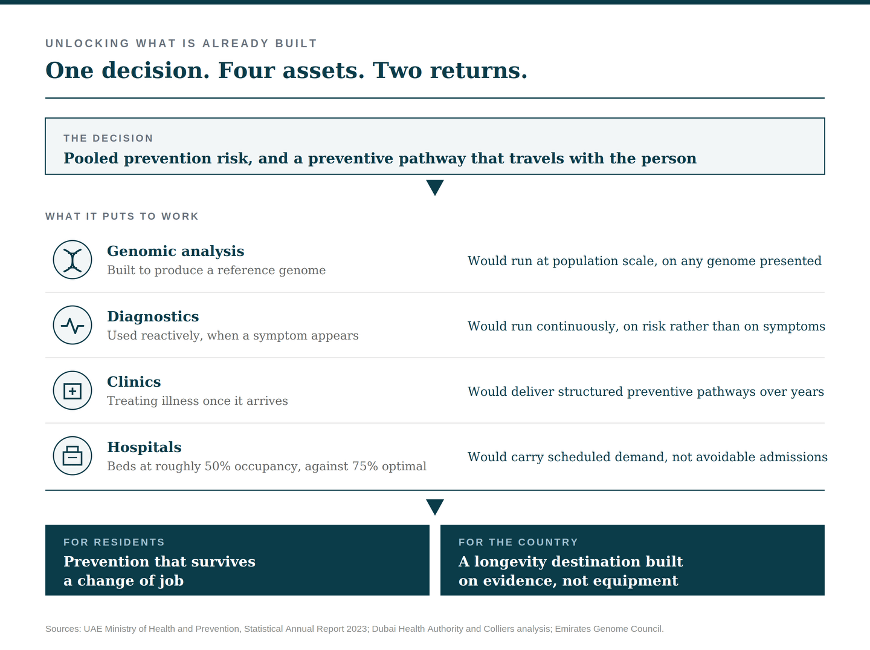
Building ahead of demand is the right way to do this, and most health systems fail to. But headroom becomes an asset only once something flows through it. National bed occupancy reached roughly 50 per cent in 2023 on the health ministry’s own figures, against an optimal level generally put at 75. The question facing the sector is no longer how much more to build. It is what to put through what has been built.
Beds are only the visible tier. Diagnostic capacity is used reactively, when a symptom sends somebody to a clinic, rather than continuously. The national sequencing capability was built to produce a reference genome, which it has done, and runs nowhere near the throughput that population-scale risk assessment would require. Each tier is expensive, each runs well below what it could carry, and for the same reason: nothing in the financing system generates the demand that would fill it.
Consider what fills the beds that are full. Almost 90 per cent of deaths in the UAE are caused by chronic lifestyle-related disease and injury, and the country has the highest diabetes prevalence in the MENA region, at 19.5 per cent of adults. That is failure demand: unplanned, unprofitable and, in a large share of cases, avoidable. It is the most expensive way there is to use a hospital bed.
The UAE has built the foundations for healthy longevity. One decision would switch them on, and make the country a leading global longevity destination
Health insurance here is bought by the employer, required before a residence permit is issued or renewed, and priced annually. If you are reading this in the Emirates, that is very probably the policy covering you. In the Northern Emirates the basic package costs around 320 dirhams a year.
Consider Karim, a composite of residents I have met. He is 43, an engineer in Dubai, and well. His father and his uncle both had heart attacks before the age of 55, and screening shows he has inherited a substantially elevated cardiac risk. Suppose his insurer is unusually far-sighted and enrols him in a prevention programme: specialist testing, imaging, medication where indicated, and regular follow-up.
In his second year he changes employer. His new employer buys cover from a different insurer, and the new insurer has no reason to continue a programme whose benefit, if it comes, will arrive long after Karim has moved on again. The programme stops. Nobody has broken a rule. The first insurer was paying for a benefit the second would collect, and the second declines to pay for one a third might collect.
That is the whole problem in one life. The return on prevention accrues to whoever holds the member when the illness fails to arrive, and in a country of high mobility that will rarely be the insurer who paid for it. Everyone behaves rationally, and nobody invests.
The problem is not new in kind. Insurance markets already pool risks that no single insurer can carry: catastrophic claims too large for one balance sheet are shared through reinsurance and common pools, and nobody considers that radical. Prevention is the same problem reversed. It is not a cost too large for one insurer to bear, but a benefit too long for one insurer to capture.
I spent eight years building and running an integrated health system across the United States and Canada, and this is the lesson that cost me most to learn. The same intervention, by the same team, for the same patient, was an asset under one contract and a liability under another. The clinical case never changed. The contract decided everything.
So the record follows the person here. The accountability does not. The Emirates has solved data portability, which is genuinely difficult, and has not yet solved risk continuity, which is easier and cheaper.
The decision is to finance prevention collectively rather than policy by policy. It has two parts, and each depends on the other.
Every insurer would contribute a small, fixed share of each premium to a shared prevention fund, governed jointly by the Department of Health in Abu Dhabi, the Dubai Health Authority and the Ministry of Health and Prevention. The fund would pay providers for a defined list of preventive services, with eligibility and outcomes tracked through Malaffi, Nabidh and Riayati, which already hold the data. Because every insurer contributes, none is paying for a benefit a competitor collects. It is the logic of catastrophic-risk pooling, applied to the other end of the problem, and the three authorities have already shown, in linking their exchanges, that they can coordinate on something considerably harder.
The record already travels; the preventive plan should travel with it. An active plan would be recorded in the exchange, and a member’s next insurer would be obliged to honour it for a defined period, across a change of employer, a gap between jobs, and back again on return. Because the pool funds the plan, continuing it costs the new insurer nothing it is not already paying. What follows a person should be not only their history but their plan.
The two parts need each other. Pooling without portability funds programmes that stop at the first change of job. Portability without pooling asks each new insurer to pay for someone else’s decision. Together they give Karim a programme that survives his career. Neither requires new public money. Both are decisions about how existing money is arranged.
Coverage, a linked national record, a genome programme and hospital capacity are built and largely paid for. The missing piece costs almost nothing. It would improve residents’ health and give the UAE an edge as a longevity destination that no competitor can replicate.
Not the ten-year interventions. The one whose value is both lifetime and immediate: genomic risk stratification. A single sequence, read once, informs drug selection, screening intervals and hereditary risk from the first year. Nobody needs to hold a member for a decade to be repaid, which makes it the right place to start.
The capability already exists at national scale. The reference genome programme was built for Emirati citizens, as it had to be, since a reference genome is by scientific necessity population-specific. The sequencing capability built around it is not. It reads any genome presented to it, and it is one of the tiers now running well below capacity.
Almost everyone with a stake in the system.
Hospital operators gain utilisation. Prevention does not compete for beds. It runs on sequencing, screening and diagnostics, the tiers furthest below capacity, and it replaces unplanned admissions with scheduled demand that can be planned, staffed and, for international patients, sold.
Insurers gain fewer avoidable high-cost claims, without subsidising their competitors, because every insurer pays in and every insurer benefits.
Regulators gain a financing mechanism that matches the preventive commitments they have already made.
Investors gain a market that does not yet exist: funded, defined demand for preventive diagnostics, services and therapies that today has no buyer.
The tourism and hospitality sector gains indirectly. Longevity care means longer stays, repeat visits and higher-value travellers, and that demand flows through to hotels and airlines as well as clinics.
The country gains a position no competitor can buy: longevity care grounded in evidence drawn from its own population, which is the subject of the next section.
And residents like Karim gain the one thing the current system cannot offer them, which is continuity.
There is also a positioning argument, and it matters more now than it did a year ago. The UAE’s health tourism ambition is not aspirational: medical tourism revenues climbed from around $197 million in 2022 to roughly $780 million in 2025, Dubai established a longevity authority this year, and the country sits within an eight-hour flight of two-thirds of the world’s population. The intent, the infrastructure and the geography are all in place.
The position being competed for is not a new one. Switzerland has held it for decades, and the Swiss clinics are now expanding outward, with longevity hubs opened in Madrid and Bangkok and further sites planned for Doha and Dubai. Singapore, Riyadh and the Emirates are all building toward the same standing, and the incumbent is opening on their doorstep.
Luxury and equipment are replicable. Every wealthy city on earth can buy a scanner and build a spa. The honest question for any destination is what it offers that Zurich, Singapore or Bangkok cannot, and the answer cannot be hospitality.
Here is where the UAE has something nobody can copy. Genomic science has a documented problem: roughly four in five samples in genome-wide association studies are of European ancestry, and the share of everyone else has been falling rather than rising. Even PharmGKB, the database clinicians rely on for drug-gene interactions, is over 60 per cent European. Risk scores built on that evidence lose accuracy when applied to South Asian, East Asian, African or Arab genomes, which is to say to most of humanity.
Britain’s biobank is the world’s most productive because one country, one health system and one linked record make the research possible at all. It is also overwhelmingly of one ancestry.
The Emirates has an equivalent structural advantage, and what Britain’s cohort lacks: diversity at scale. Eleven million people from more than two hundred nationalities, under one insurance mandate and connected through linked national records. Few places on earth could assemble a health dataset like it, and evidence generated here would travel in a way that evidence from a single-ancestry cohort cannot.
A patient from Mumbai, Jakarta or Lagos is entitled to ask on whose evidence a longevity protocol is based. A destination that can answer with data generated in a population resembling his or her own is selling something different in kind, and considerably harder to replicate than a clinic. That is what these assets, joined up, would produce: not a better spa, but the world’s most applicable preventive evidence base.
None of this argues against the direction of travel. In May of this year the President approved a unified medical insurance framework for Emiratis in every emirate, described by the Minister of Health and Prevention as advancing a preventive and sustainable national system. Emirates Health Services has launched a Healthy Longevity initiative built around genome analysis and health-risk assessment. The Itma’en programme exists explicitly to move the country from therapeutic care toward the proactive and predictive kind.
Nobody here needs persuading that prevention is the right destination. What has not yet been built is the financing mechanism that would let the majority of residents get there, and it is the least expensive thing on the list.
The UAE has done the hard parts, in a sensible order, faster than anyone else. The remaining step is the rare reform that costs almost nothing to legislate and compounds for decades. The country that completes the set will not simply improve its own health outcomes. It will become the place the world comes to for evidence-based longevity, and own the model every ageing health system on earth eventually has to copy.
Preventive healthcare in the UAE focuses on identifying health risks early, preventing avoidable diseases and supporting long-term well-being through screening, health monitoring, genomic research and personalised medical services.
Health insurance financing can influence access to long-term preventive care. When residents change employers or insurance providers, preventive programmes may be interrupted, reducing incentives for insurers to invest in benefits that emerge over several years.
Genomic medicine uses genetic information to investigate inherited disease risks, inform certain treatment decisions and support personalised screening strategies. Its potential contribution to healthy longevity depends on clinical evidence and appropriate medical interpretation.
The UAE could strengthen its position as a longevity destination by combining advanced healthcare infrastructure, genomic research, preventive medicine and medical tourism services with coordinated long-term healthcare financing.
A coordinated prevention funding model could create more consistent demand for screening and diagnostic services while potentially reducing avoidable healthcare costs over time. Its effectiveness would depend on programme design, implementation and measured health outcomes.
Preventive healthcare services in the UAE include health screenings, vaccinations, routine check-ups, chronic disease risk assessments and selected genetic testing services. Availability and insurance coverage vary by provider, emirate and health insurance policy.
Preventive healthcare can support earlier disease detection, better management of long-term health risks and fewer avoidable complications. In the UAE, coordinated preventive care could also improve the use of existing diagnostic infrastructure, reduce certain healthcare costs over time and support the country's healthy longevity ambitions.
Examples of preventive healthcare include routine health screenings, cardiovascular risk assessments, genetic risk testing where clinically appropriate, personalised screening plans and ongoing monitoring of chronic disease risks. The UAE's health data infrastructure and genomic research initiatives could support more coordinated delivery of these services.

World Health Expo
Jan 25, 2027 TO Jan 28, 2027
|Dubai, UAE
Join us at World Health Expo (WHX) in Dubai — where the world of healthcare meets. WHX connects the healthcare industry's leading researchers, developers, innovators, and professionals all in one place. Whether you're on the hunt for a new product or service, want to learn from world-renowned speakers, or expand your professional network, WHX in Dubai has everything you need to thrive in the Middle East's healthcare industry.